
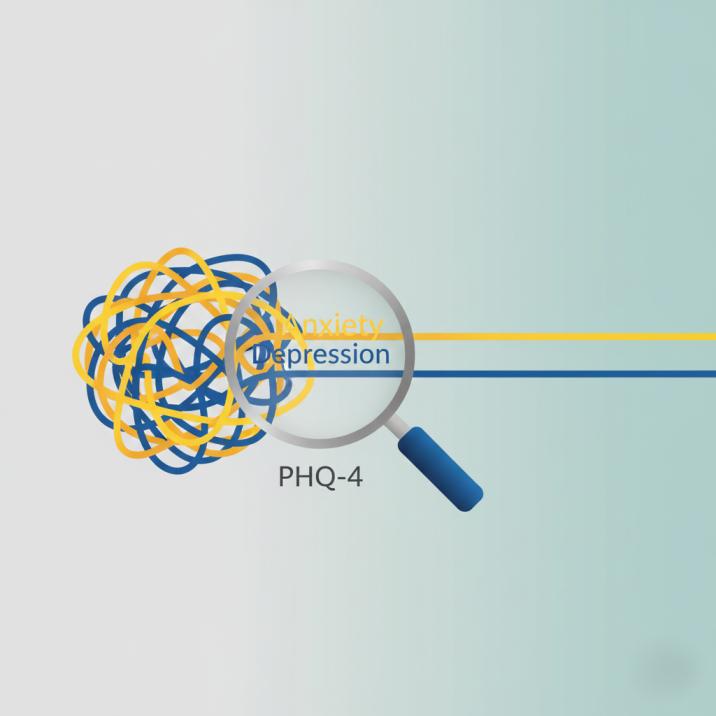
Mental health rarely fits into neat little boxes. It is surprisingly common to feel “wired” and “tired” at the same time—anxious about the future, yet too exhausted to do anything about it.
When anxiety and depression team up, they can create a confusing storm of emotions. Are you stressed because you’re down? Or are you down because you’re too stressed? Untangling this knot is the first step toward feeling better.
The Science: The “Ultra-Brief” Dual Screener
The PHQ-4 is a validated tool designed to address this exact overlap. It essentially welds together two powerful, shorter tests: the PHQ-2 (for depression) and the GAD-2 (for anxiety).
By asking just four targeted questions—two about your mood and two about your worry levels—it provides a rapid snapshot of your overall psychological distress. Researchers favor the PHQ-4 because it acknowledges that anxiety and depression are often “comorbid” (occurring together) and need to be tracked side-by-side.
The Tool: PHQ-4
This is a 4-item inventory that takes less than two minutes to complete. It is widely used in general practice clinics to decide if a patient needs more specific help.
👉 Take the Test: PHQ-4 Screening Test
What To Do With Your Score
The PHQ-4 gives you a total score (0-12) and sub-scores for both Anxiety and Depression.
- Normal (0-2): Your symptoms are likely within the normal range of daily stress.
- Mild (3-5): You might be experiencing a rough patch. Watch your stress levels and prioritize self-care.
- Moderate (6-8): These symptoms are likely impacting your daily life. It is a good time to talk to a counselor or trusted friend.
- Severe (9-12): This suggests a significant burden. A professional consultation is highly recommended to help you manage this load.
Safety & Disclaimer
This tool is for educational purposes only and is not a diagnostic instrument.
- Emergency Warning: If you are feeling hopeless or having thoughts of suicide, please reach out for help immediately. You are not alone, and support is available. Call your local emergency services (e.g., 988 in the US, or 14416 in India).
References
- Kroenke, K., et al. (2009). An ultra-brief screening scale for anxiety and depression: The PHQ-4. Psychosomatics.
- Löwe, B., et al. (2010). Validation of the Generalized Anxiety Disorder Screener (GAD-2) in a primary care sample. Annals of Family Medicine.
- Mills, S. D., et al. (2015). Psychometric properties of the PHQ-4 in a community sample. Journal of Anxiety Disorders.