
We often use the word “stressed” as a catch-all. “I’m so stressed about work.” “I’m stressed about the future.” “I’m stressed because I’m sad.”
But from a psychological perspective, stress, anxiety, and depression are three distinct animals. Treating one when you actually have the other is like taking cough syrup for a broken leg—it won’t fix the root problem.
To heal effectively, you first need to untangle the knot.
The Science: The Tri-Partite Model
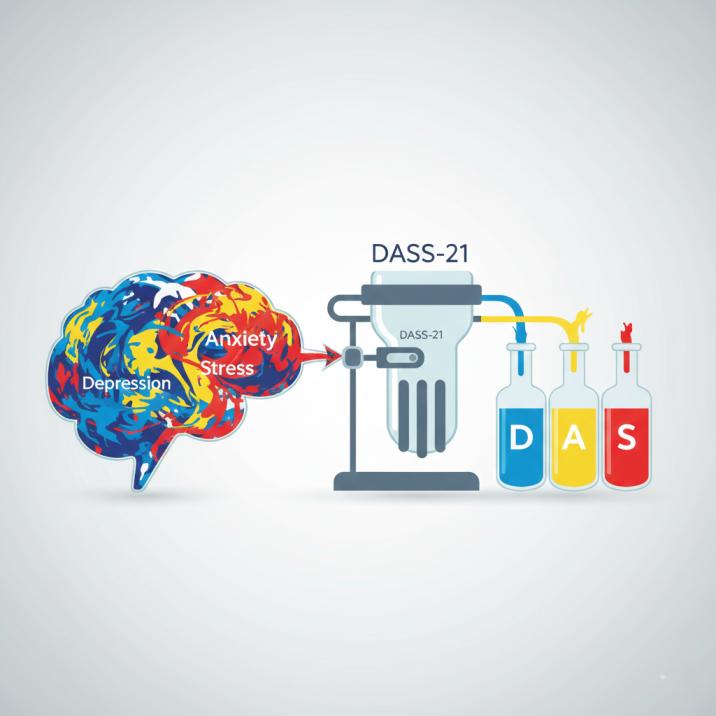
The DASS-21 (Depression Anxiety Stress Scales) is unique because it doesn’t just measure how bad you feel; it measures what specific flavor of distress you are feeling.
Researchers Lovibond and Lovibond developed this scale to clearly differentiate between three emotional states that often overlap:
- Depression: Characterized by low positive affect, loss of self-esteem and incentive, and a sense of hopelessness.
- Anxiety: Characterized by physiological arousal (racing heart, shaky hands) and fear.
- Stress: Characterized by persistent tension, irritability, and a tendency to over-react to frustrating events.
Understanding this distinction is powerful. “Stress” is about being wound too tight. “Depression” is about running out of fuel. The solutions for these are very different.
The Tool: DASS-21
This is the short-form version of the original 42-item scale. It consists of 21 statements that you rate based on how much they applied to you over the past week.
👉 Take the Test: DASS-21 Screening Test
What To Do With Your Score
The DASS-21 provides three separate scores.
- High Stress Score? Focus on relaxation. Your nervous system is over-firing. Techniques like Progressive Muscle Relaxation or simple breathing exercises are best here.
- High Anxiety Score? Focus on exposure. You are likely avoiding things out of fear. The goal is to face fears gradually to reduce the physiological response.
- High Depression Score? Focus on activation. Your system has shut down. Relaxation might actually make you feel worse (more time to ruminate). Instead, try “Behavioral Activation”—doing small, valuable tasks even if you don’t feel like it.
Safety & Disclaimer
This tool is for educational and self-monitoring purposes only.
- Scoring Note: The DASS-21 is a screening tool, not a diagnostic one. High scores indicate high distress but do not confirm a clinical disorder.
- Emergency: If you are in crisis, please contact a mental health professional or emergency services immediately (e.g., 988 in the US, 14416 in India).
References
- Lovibond, S. H., & Lovibond, P. F. (1995). Manual for the Depression Anxiety Stress Scales. (2nd. Ed.). Sydney: Psychology Foundation.
- Henry, J. D., & Crawford, J. R. (2005). The short-form version of the Depression Anxiety Stress Scales (DASS-21): Construct validity and normative data in a large non-clinical sample. British Journal of Clinical Psychology.
- Antony, M. M., et al. (1998). Psychometric properties of the 42-item and 21-item versions of the Depression Anxiety Stress Scales in clinical groups and a community sample. Psychological Assessment.