
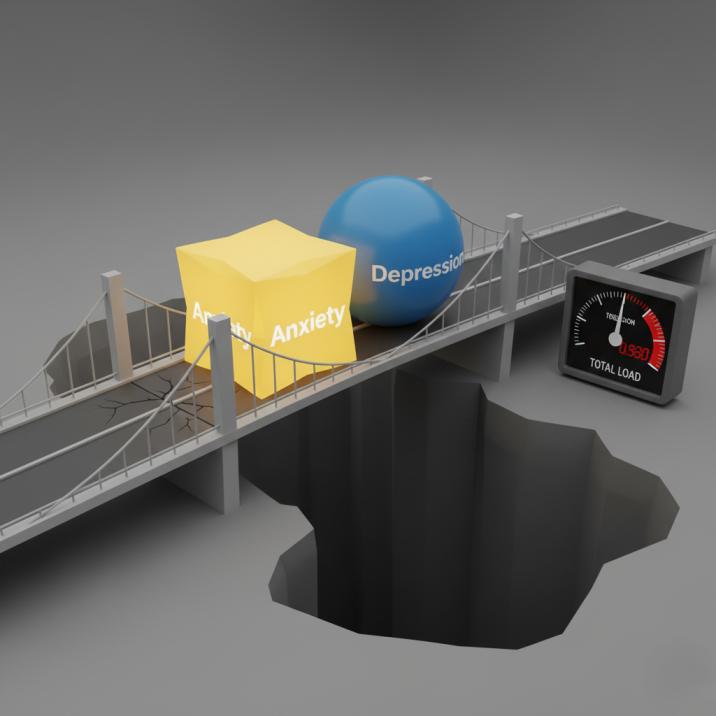
In the world of mental health, we often talk about conditions as if they are separate islands. You either visit “Anxiety Island” or “Depression Island.”
But in reality, most people live on a bridge between the two.
It is incredibly common to feel the heavy, slow fog of depression and the racing, sharp edge of anxiety at the same time. When these two collide, they don’t just add up; they multiply. The fatigue of depression makes it harder to cope with anxiety, and the exhaustion of anxiety deepens the depression.
To understand your true mental state, you need to measure the total load.
The Science: The Sum of Its Parts
The PHQ-ADS (Patient Health Questionnaire – Anxiety and Depression Scale) is a composite measure. It combines the scores of two of the most respected tools in psychology: the PHQ-9 (for depression) and the GAD-7 (for generalized anxiety).
Why combine them? Research published in Psychosomatic Medicine suggests that measuring a patient’s “global distress”—the total psychological burden—is often more useful for predicting health outcomes than looking at the diagnoses separately. It acknowledges that your brain is dealing with a cumulative weight, and that total score is the best indicator of how much support you need right now.
The Tool: PHQ-ADS
This is a comprehensive assessment. It consists of 16 questions (9 for depression, 7 for anxiety). It provides a single score ranging from 0 to 48.
👉 Take the Test: PHQ-ADS Anxiety & Depression Test
What To Do With Your Score
The PHQ-ADS score helps you categorize the “weight” you are carrying:
- Mild (0-9): You are likely coping well, though you may have occasional bad days.
- Moderate (10-19): The burden is becoming noticeable. It might be affecting your energy or work.
- Severe (20-29): This is a significant load. You likely feel overwhelmed daily. Therapy is strongly recommended to help “offload” some of this weight.
- Very Severe (30-48): You are carrying an immense amount of distress. At this level, the combination of anxiety and depression can be paralyzing. Please reach out to a doctor or psychiatrist—medication and therapy are often very effective at this stage.
Safety & Disclaimer
This tool is for educational purposes only and is not a medical diagnosis.
- Self-Harm Warning: This test includes questions about thoughts of self-harm. If you answered “several days” or more to that specific question, or if you feel unsafe, please seek immediate help.
- Emergency: Call your local emergency number (e.g., 988 in the US, 14416 in India).
References
- Kroenke, K., et al. (2016). The Patient Health Questionnaire Somatic, Anxiety, and Depressive Symptom Scales: a systematic review. General Hospital Psychiatry.
- Kroenke, K., Wu, J., Yu, Z., Bair, M. J., Kean, J., Stump, T., & Monahan, P. O. (2016). Patient Health Questionnaire Anxiety and Depression Scale: Initial validation in three clinical trials. Psychosomatic Medicine.
- Löwe, B., et al. (2008). Validation of the Generalized Anxiety Disorder Screener (GAD-7) in a primary care sample. Medical Care.