
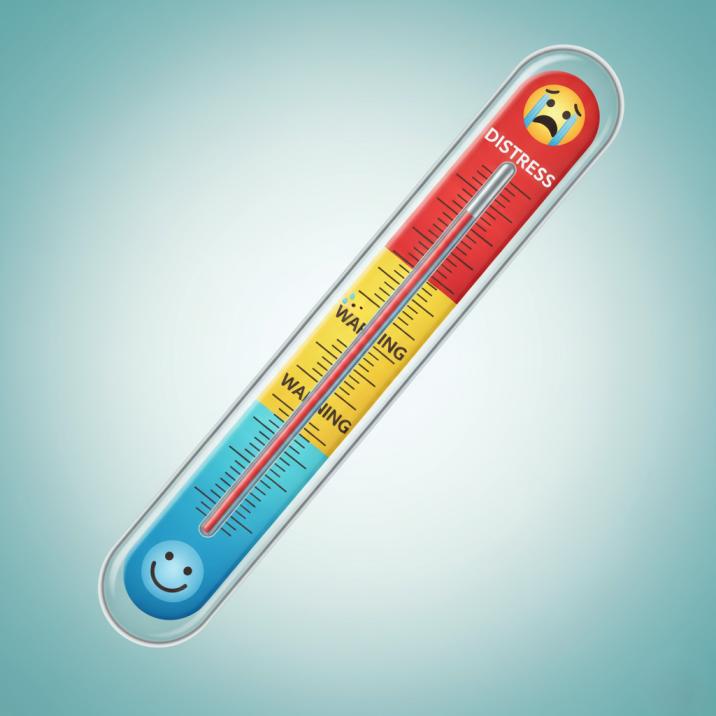
We brush our teeth to maintain dental hygiene. We check our temperature to see if we have a fever. But what do we do for our emotional hygiene?
Most of the time, we ignore our mental state until we hit a breaking point. We push through the stress, the fatigue, and the irritability until we simply crash.
The K10 (Kessler Psychological Distress Scale) offers a better way. It acts as a thermometer for your mind, allowing you to catch “emotional fevers” before they become emergencies.
The Science: The Global Standard
Developed by Harvard professor Ronald Kessler, the K10 (and its shorter cousin, the K6) is one of the most widely used mental health tools on the planet.
It is the tool of choice for the World Health Organization (WHO) and annual government health surveys in countries like Australia, Canada, and the USA. Why? Because it doesn’t get bogged down in specific diagnoses. It doesn’t care why you are stressed; it simply measures the severity of your “non-specific psychological distress.”
It tracks how often in the past 30 days you felt nervous, hopeless, restless, or depressed. It is the perfect broad-spectrum check-up.
The Tool: K10 & K6
The K10 consists of 10 questions about your emotional state over the last 4 weeks. The K6 is an ultra-short 6-question version for rapid screening.
👉 Take the Test: K10 & K6 Psychological Distress Test
What To Do With Your Score
Scores generally fall into four zones of mental health:
- Well (Score under 20): You are likely functioning well. Keep up your current habits.
- Mild (20-24): You are showing some sensitivity to stress. Consider proactive self-care like exercise or meditation.
- Moderate (25-29): There is a solid chance of a mild mental disorder (like anxiety). It is advisable to talk to a GP or counselor.
- Severe (30+): You are likely experiencing significant distress. This score is highly correlated with severe depression or anxiety disorders. Professional support is strongly recommended.
Safety & Disclaimer
This tool is for educational and self-monitoring purposes only.
- Not a Diagnosis: A high K10 score indicates distress, but it does not tell you which condition you might have. Only a doctor can determine that.
- Emergency: If you feel life is not worth living, please seek help immediately. Call your local emergency services (e.g., 988 in the US, 14416 in India).
References
- Kessler, R. C., et al. (2002). Short screening scales to monitor population prevalences and trends in non-specific psychological distress. Psychological Medicine.
- Kessler, R. C., et al. (2003). Screening for serious mental illness in the general population. Archives of General Psychiatry.
- Andrews, G., & Slade, T. (2001). Interpreting scores on the Kessler Psychological Distress Scale (K10). Australian and New Zealand Journal of Public Health.