
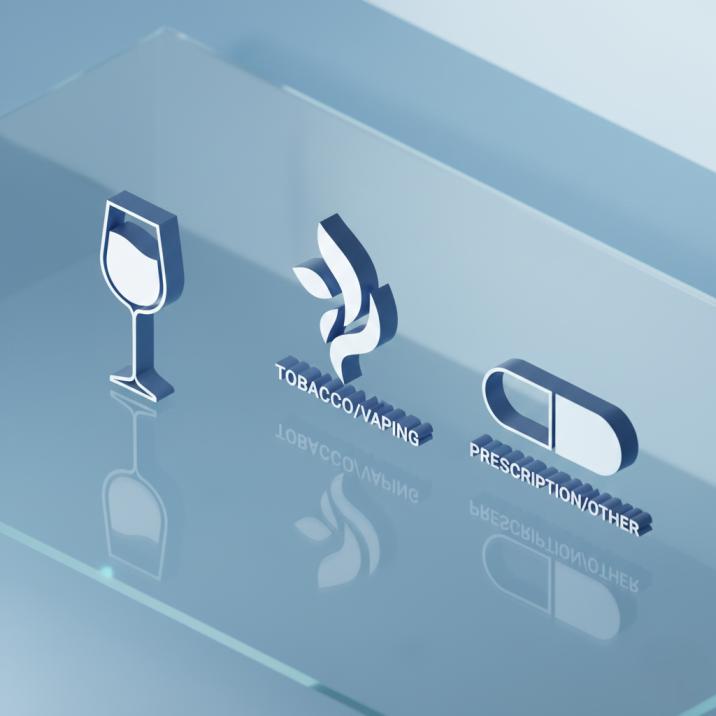
When you go for a physical, your doctor checks your blood pressure, your heart rate, and your weight. These are the “vital signs” of your physical body.
But there is another set of vital signs that often gets skipped: your substance health.
We often treat alcohol, tobacco, and prescription meds as separate things. You might be a “social smoker” but never drink, or you might drink daily but never touch drugs. However, from a health perspective, they all interact with your body’s chemistry. To get a true picture of your health, you need to scan the whole dashboard at once.
The Science: The “Check Engine” Light
The NIDA Quick Screen was developed by the National Institute on Drug Abuse to serve as a universal “triage” tool.
It is designed to be incredibly fast. It asks a single question about four key areas:
- Alcohol (Heavy drinking days)
- Tobacco (Smoking, vaping, etc.)
- Prescription Drugs (Used for non-medical reasons)
- Illegal Drugs
Research shows that this simple “pre-screen” is highly effective. If you answer “Never” to all four, you are statistically at very low risk for substance-related health problems. If you answer “Yes” to any, it acts as a “check engine” light, signaling that we need to look under the hood with a more detailed assessment.
The Tool: NIDA Quick Screen
This tool is often the first step in the “NIDA-Modified ASSIST.” It asks about your usage over the past year.
👉 Take the Test: NIDA Quick Screen
What To Do With Your Score
- All “Never”: You are in the clear! No intervention is needed.
- Any “Yes”: This indicates a potential risk.
- Alcohol: If you exceed the daily limits (4 for men, 3 for women), you are at risk for long-term health issues even if you don’t feel “drunk.”
- Tobacco: Any use is considered a health risk.
- Drugs: Any non-medical use warrants a deeper look.
- Next Steps: If you flagged a “Yes” on this screen, the medically recommended next step is to take the NIDA-Modified ASSIST (Tier 2) assessment to determine the severity of the risk.
Safety & Disclaimer
This tool is for educational purposes only and is not a medical diagnosis.
- Honesty Policy: This test is only as good as the data you put in. Since it is anonymous, try to be brutally honest with yourself for the most accurate result.
- Emergency: If you are experiencing withdrawal symptoms or overdose, call emergency services immediately (e.g., 988 in the US, 14416 in India).
References
- National Institute on Drug Abuse. (2010). Resource Guide: Screening for Drug Use in General Medical Settings.
- Smith, P. C., et al. (2010). A single-question screening test for drug use in primary care. Archives of Internal Medicine.
- McNeely, J., et al. (2014). Validation of the NM-ASSIST: A brief screening tool for substance use disorders. Journal of Substance Abuse Treatment.