
For decades, doctors in India had to rely on Western tools like the CARS or ADOS to diagnose autism. While effective, these tools often posed a challenge: they were designed for children in New York or London, not New Delhi or Kochi.
Cultural norms around eye contact, social play, and independence differ wildly across the globe. A child in India might avoid eye contact out of respect, not necessarily due to autism. Using a foreign yardstick to measure an Indian child often led to confusion.
That changed with the arrival of the ISAA.
The Science: Made for India
The Indian Scale for Assessment of Autism (ISAA) was developed by the National Institute for the Mentally Handicapped (now NIEPID).
It was a landmark project that established a standardized tool validated specifically on the Indian population. It assesses 40 items across six domains:
- Social Relationship and Reciprocity
- Emotional Responsiveness
- Speech-Language and Communication
- Behavior Patterns
- Sensory Aspects
- Cognitive Component
Crucially, the ISAA is the only scale officially recognized by the Government of India for issuing Disability Certificates and UDID Cards for autism. If parents want to avail government benefits, concessions, or school accommodations, an ISAA score is mandatory.
The Tool: ISAA
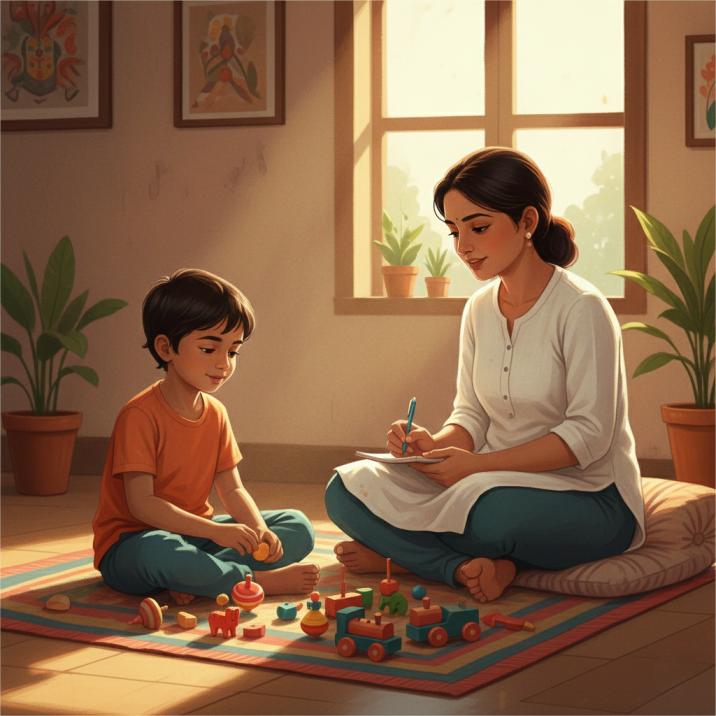
This is a clinician-administered scale. It takes about 45 minutes and involves observing the child, interviewing the parents, and testing specific skills.
👉 Access the Guide: ISAA Indian Scale for Assessment of Autism
What To Do With Your Score
The ISAA provides a total score ranging from 40 to 200, classifying the severity of autism:
- < 70: No Autism
- 70 – 106: Mild Autism
- 107 – 153: Moderate Autism
- > 153: Severe Autism
For Parents: If your child receives a diagnosis via ISAA, the next step is to apply for a UDID Card (Unique Disability ID) through the Swavlamban portal. This card is your gateway to rights and resources under the RPwD Act, 2016.
Safety & Disclaimer
This content is for educational purposes and professional reference.
- Professional Use Only: The ISAA should only be administered by a clinical psychologist or a trained medical professional. Parents cannot self-score this tool for an official diagnosis.
- Holistic View: A score is just a number. It does not define the child’s potential. Early intervention (occupational therapy, speech therapy) matters far more than the specific score.
References
- National Institute for the Mentally Handicapped (NIMH). (2009). Indian Scale for Assessment of Autism (ISAA). Secunderabad: NIMH.
- Patra, S., & Arun, P. (2011). Use of Indian Scale for Assessment of Autism (ISAA) in children with intellectual disability. Journal of Indian Association for Child and Adolescent Mental Health.
- Chakrabarti, S. (2014). The rights of persons with disabilities act, 2016: A new dawn for autism in India?