
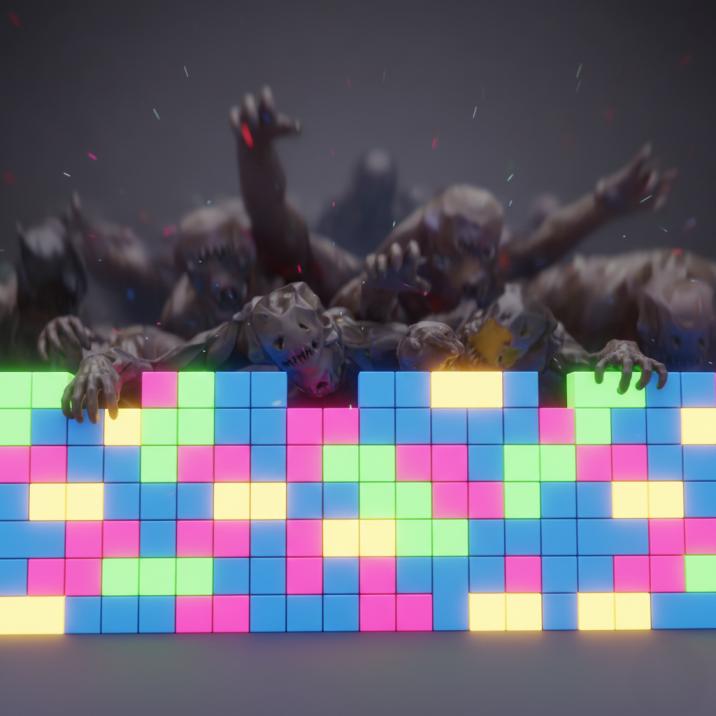
PTSD isn’t just about remembering a bad event. It is about reliving it.
A car backfires, and suddenly you aren’t on the street anymore; you are back in the war zone. A specific smell hits you, and you are back in that room. These are intrusive memories or flashbacks. They happen because the memory of the trauma wasn’t filed away correctly in the brain’s history books—it is still floating around in the “Now,” raw and vivid.
For years, we thought the only way to fix this was talk therapy. But fascinating new research suggests that a simple visual game might act as a “cognitive vaccine” against these flashbacks.
Flash Breaker puts this research into practice.
The Science: The “Tetris Effect”
This tool is inspired by the groundbreaking work of Dr. Emily Holmes and colleagues at Oxford University and the Karolinska Institute.
Their research found that the human brain has a limited “bandwidth” for processing visual information. If you engage in a highly demanding Visuospatial Task (like playing Tetris or rotating shapes mentaly) shortly after a traumatic trigger, you “jam” the signal.
Essentially, your brain is too busy rotating the colorful blocks to vividly visualize the traumatic image. Because it can’t visualize it deeply, it can’t “consolidate” (save) the memory as an intrusive flashback. It becomes just a regular, fuzzy memory—bad, but not haunting.
The Game: Flash Breaker
Flash Breaker is a high-intensity visual rotation game.
- The Task: You are shown complex 3D shapes and must mentally rotate them to fit into a specific hole or match a pattern.
- The Key: It requires 100% of your visual focus. You cannot think about anything else while playing.
👉 Play the Game: Flash Breaker
Actionable Advice
- The Golden Window: Research suggests this technique is most effective within 6 hours of a traumatic event (or a re-triggering of that memory).
- Use as a “Fire Extinguisher”: If you feel a flashback coming on, or if you have just been triggered by something you saw, open Flash Breaker immediately. Play for 10-20 minutes. The goal is to occupy your visual cortex until the emotional intensity subsides.
- Not Avoidance: This is not about “repressing” feelings. It is about stopping the visual intrusion. You can and should process the emotions later with a therapist, but you don’t need to suffer the visual horror on a loop.
Safety & Disclaimer
- This tool is for educational and coping purposes.
- Not a Cure: This is an experimental coping mechanism based on preliminary research. It is not a cure for PTSD.
- Professional Help: If you have PTSD, please work with a trauma-informed therapist. EMDR and CPT are proven clinical treatments that go deeper than this tool.
References
- Holmes, E. A., et al. (2009). Can playing the computer game “Tetris” reduce the build-up of flashbacks for trauma? A proposal from cognitive science. PLoS ONE.
- Iyadurai, L., et al. (2018). Intrusive memories of trauma: A target for research bridging cognitive science and its clinical application. Clinical Psychology Review.
- Kessler, H., et al. (2018). Visuospatial computer game play after memory reactivation reduces intrusive memories of experimental trauma. Journal of Consulting and Clinical Psychology.