
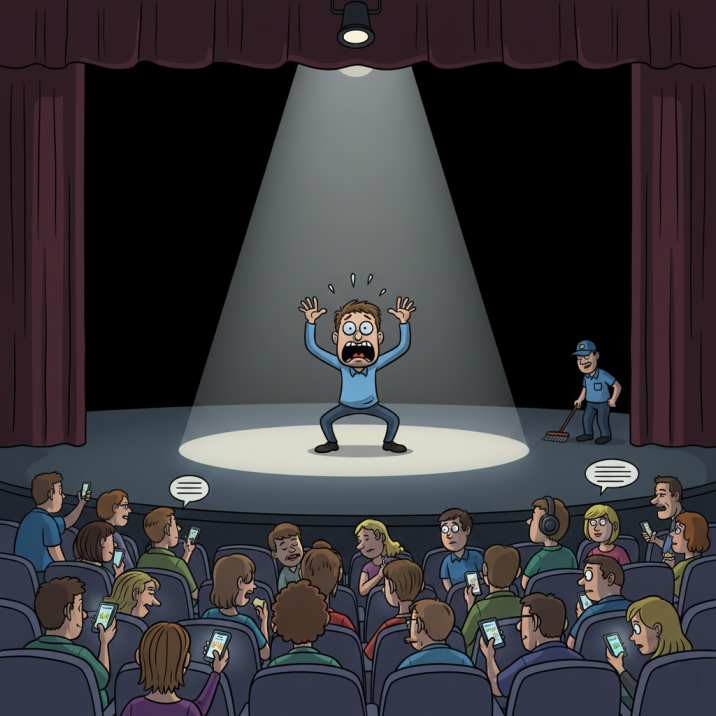
You spill a tiny drop of coffee on your shirt. Your brain: “Everyone sees it. They are all staring. I look like a slob. This is a disaster.”
Reality: Nobody noticed. And if they did, they forgot about it 3 seconds later because they were worrying about the coffee stain on their shirt.
This psychological phenomenon is known as the Spotlight Effect. We walk through life feeling like the main character in a movie, assuming that everyone else is the audience. We overestimate how much people notice our appearance, our mistakes, and our nervousness.
Social Spotlight is a reality-testing game designed to dim that blinding light.
The Science: Egocentric Bias
The Spotlight Effect stems from Egocentric Bias. We are the center of our own universe, so we struggle to step outside our own head and see things from another person’s perspective.
In a famous study at Cornell University, students were asked to wear an embarrassing t-shirt (featuring Barry Manilow) and walk into a classroom. The students predicted that 50% of the class would notice. The reality? Only roughly 20% did.
We consistently overestimate our visibility by a factor of two or three.
The Game: Social Spotlight
This is a Perspective-Taking Simulation.
- The Scenario: You watch a video or animation of a crowded room where a character does something slightly embarrassing (e.g., trips, stutters).
- The Prediction: The game asks: “How many people in the room noticed?” (You place your bet).
- The Reveal: The game reveals the “Headspace” of the other characters.
- Character A: “I’m hungry.”
- Character B: “Did I lock my car?”
- Character C: “I hope she likes me.”
- The Lesson: You realize that while the main character was panicking, everyone else was consumed by their own internal monologue.
👉 Play the Game: Social Spotlight
Actionable Advice
- Look Outward: When you feel self-conscious, turn your attention out. Look at the color of the walls. Look at someone else’s shoes. You can’t be self-conscious and observant at the same time.
- The “So What?” Defense: Okay, so someone did see you trip. So what? Will they remember it in 10 years? 10 days? 10 minutes? Probably not.
Safety & Disclaimer
- This tool is for building confidence.
- Social Phobia: If your fear of scrutiny is so intense that it prevents you from leaving the house, please consult a therapist. This might be Social Anxiety Disorder, which is highly treatable.
References
- Gilovich, T., Medvec, V. H., & Savitsky, K. (2000). The spotlight effect in social judgment: An egocentric bias in estimates of the salience of one’s own actions and appearance. Journal of Personality and Social Psychology.
- Savitsky, K., & Gilovich, T. (2003). The illusion of transparency and the alleviation of speech anxiety. Journal of Experimental Social Psychology.