
Your boss asks to see you in his office. Instant Thought: “I’m getting fired.”
Your partner doesn’t text back for 2 hours. Instant Thought: “They are cheating on me.”
Why does our brain always jump to the worst-case scenario? This is the Negativity Bias. It kept our ancestors alive (it’s better to mistake a stick for a snake than a snake for a stick), but in modern life, it just makes us miserable.
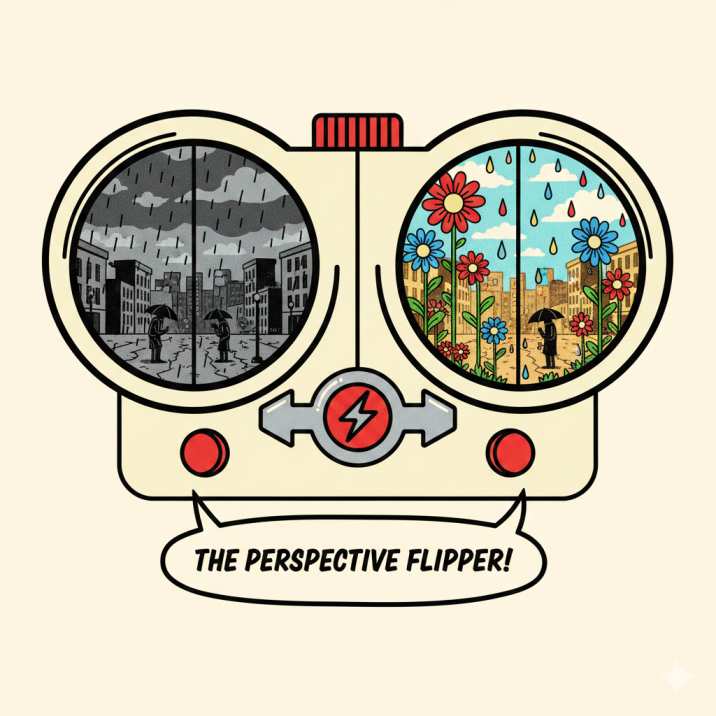
We become trapped in a single, gloomy interpretation of reality. To break free, we need to cultivate Cognitive Flexibility. We need to train our brains to see that for every negative story, there are at least three other possibilities.
Bias Reverser is a gym for your imagination.
The Science: Alternative Explanations
In therapy, this technique is often called “Generating Alternatives.”
When you are depressed or anxious, your thinking becomes rigid. You develop “Tunnel Vision.” Bias Reverser forces the brain to widen the aperture.
Studies in Social Cognitive and Affective Neuroscience suggest that the act of actively generating positive interpretations engages the Ventrolateral Prefrontal Cortex (VLPFC), which dampens the amygdala response. You are literally thinking your way out of fear.
The Game: Bias Reverser
- The Prompt: You are dealt a “Bad News” card. (e.g., “You waved at a friend, and they didn’t wave back.”)
- The Challenge: You have 10 seconds to type (or select) a Non-Catastrophic Reason.
- Maybe they didn’t have their glasses on.
- Maybe they were lost in thought.
- Maybe they were waving at someone behind me.
- The Score: You get points for speed and creativity. The goal is to train your brain so that the “Alternative Explanation” pops up as fast as the “Negative” one.
- The Note: This game is a bespoke creation of PsychKit.org, designed to gamify the “CBT Three-Column Technique.”
👉 Play the Game: Bias Reverser
Actionable Advice
- The “Rule of 3”: Make a deal with yourself. You are allowed to worry about the worst-case scenario, BUT only after you have listed 3 other possible scenarios first.
- The “Best Case” Scenario: We always ask “What if it goes wrong?” Try asking “What if it goes right?” Just as a mental experiment. What would that look like?
Safety & Disclaimer
- This tool is for cognitive training.
- Toxic Positivity: This isn’t about pretending bad things don’t happen. If your boss actually fires you, that sucks. This tool is for the moments before you know the truth, to save you from suffering twice.