
“I’m just mad!”
When we are emotional, we often use big, vague labels. We say we are “stressed” or “upset.” But “stressed” is a useless word. You can’t fix “stressed.”
Can you fix “overstimulated by the loud TV”? Yes. Can you fix “feeling disrespected by my boss”? Yes. Can you fix “low blood sugar”? Yes.
The key to emotional regulation is Emotional Granularity—the ability to be specific. The more precise you are about what you are feeling and why, the easier it is to regulate. But when the red mist descends, it’s hard to think clearly.
Trigger Tuner acts as a diagnostic checklist for your mood.
The Science: Affect Labeling
UCLA neuroscientist Matthew Lieberman found that simply naming an emotion (“I am feeling angry”) reduces activity in the amygdala. This is called Affect Labeling.
It engages the Ventrolateral Prefrontal Cortex, which puts the brakes on the emotional center. Trigger Tuner takes this a step further by not just naming the emotion, but identifying the antecedent (the cause). It moves you from “experiencing” the emotion to “analyzing” it.
The Game: Trigger Tuner
- The Alarm: You start the tool when you feel a surge of negative emotion.
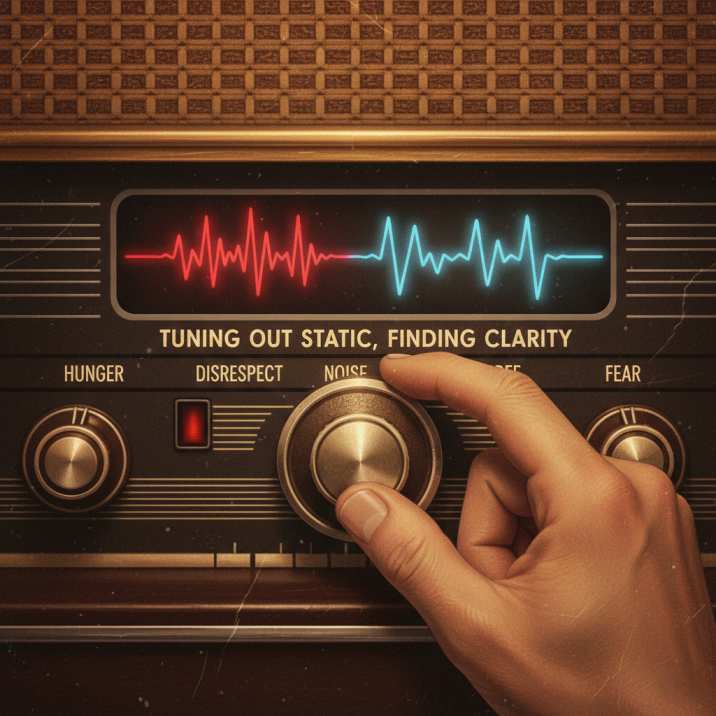
- The Tuning: You are presented with a series of dials representing common biological and psychological triggers.
- Dial 1: Biology (Hunger, Sleep, Pain).
- Dial 2: Sensory (Noise, Lights, Crowds).
- Dial 3: Ego (Rejection, Failure, Disrespect).
- The Lock: You adjust the dials until you find the combination that matches your current state.
- The Reveal: The tool gives you a specific summary: “You aren’t just mad. You are overstimulated and hungry.”
- The Copyright: Trigger Tuner © PsychKit.org provides a structured interface to deconstruct the “blob” of emotion into solvable parts.
👉 Start Tuning: Trigger Tuner
Actionable Advice
- The “HALT” Protocol: Before you start a difficult conversation, run a quick diagnostic. Am I Hungry, Angry, Lonely, or Tired? If yes, fix that first.
- Sensory Overload: Adults get overstimulated too. If you are snapping at your family, check the noise level. Turn off the TV. Dim the lights. You might be surprised how quickly the “anger” vanishes.
Safety & Disclaimer
- This tool is for self-regulation.
- Deep Trauma: Some triggers are linked to deep past trauma (PTSD). If you find a trigger that causes a panic attack or dissociation, exploring it with a therapist is safer than doing it alone.
References
- Lieberman, M. D., et al. (2007). Putting feelings into words: Affect labeling disrupts amygdala activity in response to affective stimuli. Psychological Science.
- Kashdan, T. B., et al. (2015). Unpacking emotion differentiation: Transforming unpleasant experience by perceiving distinctions in emotion. Current Directions in Psychological Science.
- Barrett, L. F. (2017). How Emotions Are Made: The Secret Life of the Brain. Houghton Mifflin Harcourt.