
Imagine walking into a party.
There are 20 people smiling and having a good time, but one person in the corner is frowning and looking at their phone. If you have anxiety, who does your brain focus on?
You ignore the 20 smiles and zoom in on the frown. You think, “They hate me. I shouldn’t be here.”
This is called Attention Bias to Threat. It is an evolutionary survival mechanism gone rogue. Your brain’s “smoke detector” (the amygdala) is set so sensitively that it constantly scans the room for danger, completely missing the safety and joy that is right in front of it.
The problem is, this happens automatically. You don’t choose to do it. But science suggests you can unlearn it.
The Science: Attention Bias Modification (ABM)
Calm Shift is based on a therapeutic technique called Attention Bias Modification (ABM).
Research has shown that anxious individuals have a “vigilance-avoidance” pattern—they quickly spot threats but struggle to disengage from them. ABM works by turning the table. It forces your brain to repeatedly practice a new habit: Ignoring the threat and finding the safety.
Studies published in journals like the American Journal of Psychiatry have found that a simple computerized task—finding a smiling face among angry ones—can actually lower anxiety symptoms over time. It creates a “cognitive vaccine,” making you less reactive to stress because your brain stops actively looking for it.
The Game: Calm Shift
The gameplay is repetitive by design—it is a drill for your neurons.
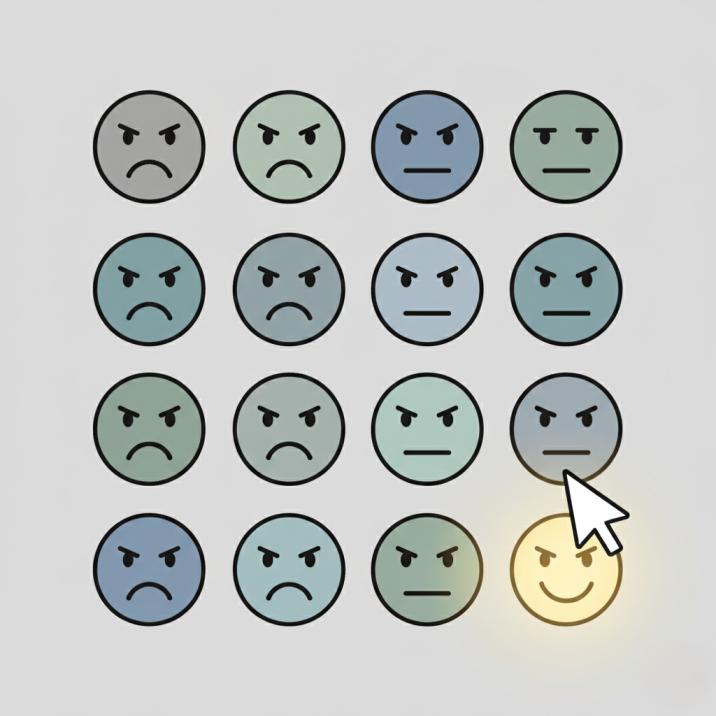
- A grid of faces appears on the screen.
- Most faces are angry or disgusted.
- One face is happy or neutral.
- Your job: Click the happy face as fast as possible.
As you play, the game speeds up. Your brain learns that “Happy = Target” and “Angry = Distraction.” Slowly, this rewires your automatic search pattern.
👉 Play the Game: Calm Shift Anxiety Game
Actionable Advice
- Consistency is Key: You can’t go to the gym once and get muscles. Similarly, you can’t play Calm Shift once and cure anxiety. Try playing for 5 minutes every morning for two weeks.
- Real World Application: After playing, try it in real life. When you are on the bus or in a meeting, consciously try to count how many people look calm or friendly. Manually override your brain’s desire to find the grumpy person.
Safety & Disclaimer
- This game is for educational and wellness purposes.
- Not a Replacement for Therapy: ABM is a supplement to therapy (like CBT), not a replacement. If you have severe anxiety or panic attacks, please see a mental health professional.
References
- Hakamata, Y., et al. (2010). Attention bias modification treatment: A meta-analysis toward the establishment of novel treatment for anxiety. Biological Psychiatry.
- Bar-Haim, Y., et al. (2007). Threat-related attentional bias in anxious and nonanxious individuals: A meta-analytic study. Psychological Bulletin.
- MacLeod, C., et al. (2002). Selective attention and emotional vulnerability: Assessing the causal basis of their association through the experimental manipulation of attentional bias. Journal of Abnormal Psychology.