
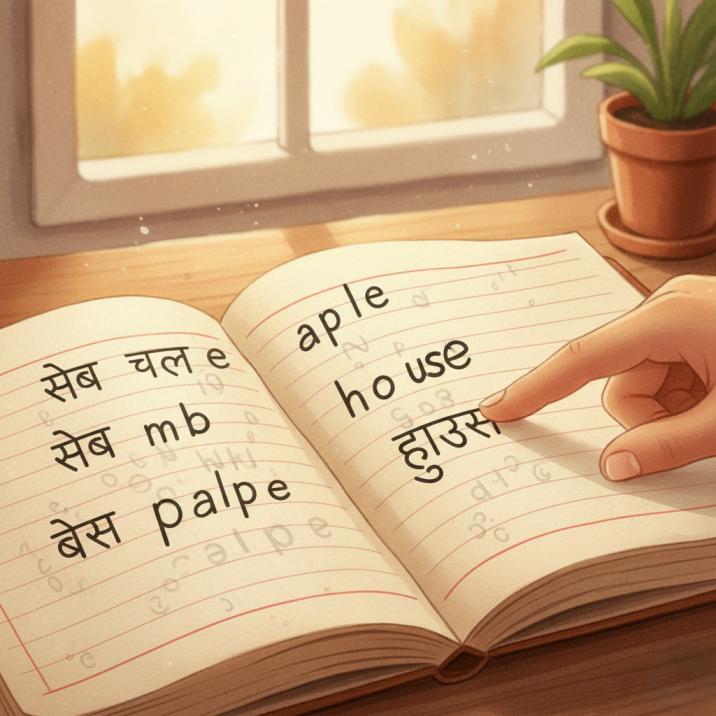
Dyslexia is often misunderstood as just “reading backwards.” But in reality, it is a complex difficulty with processing language.
For years, identifying dyslexia in India was a nightmare. Why? Because almost all the tests were in English.
But an Indian child typically grows up speaking two or three languages. They might speak Hindi at home, learn Marathi in the neighborhood, and study English at school. A test that only checks English might label a child as “dyslexic” when they are actually just struggling with a second language, or conversely, miss a child who is dyslexic because they have memorized English sight words but can’t read their mother tongue.
We needed a tool that understood the Indian brain. That tool is DALI.
The Science: Decoding Indian Scripts
DALI (Dyslexia Assessment for Languages of India) was developed by the National Brain Research Centre (NBRC).
It is a scientific breakthrough because it accounts for the unique structure of Indian languages. Unlike English, which is “opaque” (letters don’t always match sounds—think “tough” vs “dough”), Indian languages are “transparent” (you write exactly what you speak).
DALI contains screening tools for school teachers and detailed assessment batteries for psychologists in four languages: Hindi, Marathi, Kannada, and English. It allows clinicians to distinguish between a language barrier and a true neurological learning disability.
The Tool: DALI
The DALI package includes screening tools (JSTs) for teachers to quickly identify at-risk children in classrooms.
👉 Access the Tool: DALI Parent & Teacher Handout
What To Do With Your Score
- Teacher Screening: If a teacher uses the DALI screener and flags a student, it provides the objective data needed to talk to parents without sounding accusatory.
- Formal Diagnosis: A full DALI assessment by a psychologist is accepted by major educational boards (like CBSE and ICSE).
- The Benefit: A formal diagnosis unlocks critical Exam Accommodations. In India, a child with certified dyslexia is entitled to:
- Extra time (usually 20 minutes per hour) in board exams.
- Exemption from the third language requirement.
- A Scribe (writer) in severe cases.
Safety & Disclaimer
This content is for educational purposes.
- Multilingual Check: If a child struggles in English but reads Hindi perfectly, they likely do not have dyslexia. Dyslexia affects the brain’s processing of all languages.
- Visual Issues: Always check the child’s eyesight and hearing before testing for learning disabilities.
References
- National Brain Research Centre (NBRC). (2015). DALI: Dyslexia Assessment for Languages of India.
- Singh, N. C., et al. (2015). Dyslexia Assessment for Languages of India (DALI): Development and validation. Annals of Neurosciences.
- Thapa, K., & Singh, N. C. (2018). Prevalence of specific learning disabilities among school going children in India.