
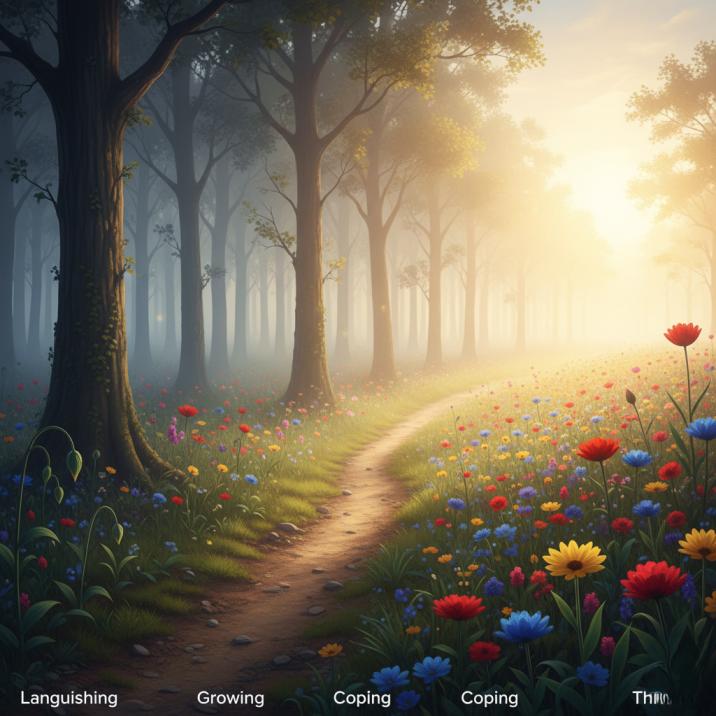
For a long time, we viewed mental health like a light switch: you were either “mentally ill” or you were “healthy.” But life is rarely that black and white. Most of us live in the grey area in between.
Have you ever felt like you weren’t depressed, but you weren’t exactly happy either? You’re just… getting by. You feel a bit empty, a bit stagnant, like you’re looking at the world through a foggy window. This state has a name: Languishing.
On the other end of the scale is Thriving (or Flourishing)—a state where you feel connected, purposeful, and full of vitality. Understanding that mental health is a continuum is one of the most empowering shifts you can make. It means that even if you aren’t “sick,” there is always room to move toward a more vibrant life.
As the psychologist Corey Keyes, who pioneered this research, says:
“The absence of mental illness does not imply the presence of mental health.”
The Mental Health Continuum Model
The continuum model suggests that mental health and mental illness are two different things. You can have a diagnosed mental health condition but still be “flourishing” by managing it well. Conversely, you can have no diagnosis at all but still be “languishing.”
1. Languishing: The “Meh” of Mental Health
Languishing is the neglected middle child of mental health. It’s not the presence of misery, but the absence of well-being. You might feel:
- Unmotivated or “stuck.”
- Disconnected from your friends or hobbies.
- A lack of clear purpose or direction.
2. Thriving: The State of Flourishing
Thriving is when you are functioning at your best. This doesn’t mean life is perfect; it means you have the tools to handle the waves. It includes:
- Emotional Well-being: Feeling generally positive and satisfied with life.
- Social Well-being: Feeling like you belong and contribute to a community.
- Psychological Well-being: Feeling that you are growing and have autonomy.
Check Your Position: The Mental Health Continuum – Short Form (MHC-SF)
How do you know where you currently sit on this line? Researchers use the MHC-SF, a scientifically validated 14-item scale that looks at the three pillars of a good life: emotional, social, and psychological health.
By taking a few minutes to reflect on these areas, you can see if you are currently languishing, flourishing, or sitting somewhere in the middle (moderate mental health). This isn’t a grade; it’s a compass.
➡️ Take the Mental Health Continuum (MHC-SF) Check-In Now
How to Move Toward “Thriving”
If you find yourself languishing, the goal isn’t to jump to “perfect” overnight. The goal is movement.
- Find “Flow”: Engage in an activity that challenges you just enough to lose track of time. Try our Focus Flow Game to practice getting into that state.
- Small Wins: Languishing often feels like paralysis. Use The Tiny Habits Method to achieve one small thing today.
- Connect: Reach out to one person. If you find social interaction difficult, our GIVE Skill guide can give you a simple structure to follow.
Safety and User Responsibility
PsychKit is a digital laboratory for self-discovery and resilience. We provide these tools to help you navigate the grey areas of life and build a foundation for flourishing.
Important Disclaimer: The MHC-SF and other tools on this site are for educational and self-awareness purposes. They are not clinical diagnostic tools, medical advice, or a substitute for therapy. You are responsible for how you interpret and act upon your results.
Emergency Notice: If you are feeling a deep sense of despair, hopelessness, or are in a mental health crisis, please do not wait. Visit your nearest Emergency Department or contact a local crisis hotline immediately. Digital tools cannot replace the safety and support provided by trained medical professionals in an emergency.
References & Scientific Sources
- Keyes, C. L. M. (2002). The mental health continuum: From languishing to flourishing in life. Journal of Health and Social Behavior, 207–222.
- Westerhof, G. J., & Keyes, C. L. M. (2010). Mental illness and mental health: The two-continua model across the life span. Evidence-based Mental Health, 13(4), 110.
- Lamers, S. M., et al. (2011). The psychometric properties of the Mental Health Continuum-Short Form (MHC-SF). Journal of Clinical Psychology, 67(1), 99–110.