
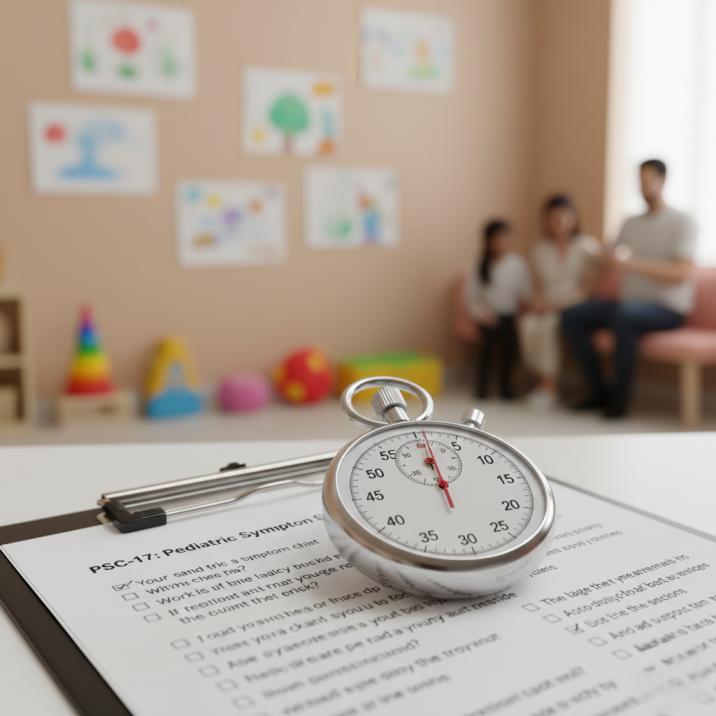
Primary care visits are short. By the time you measure height, check weight, and give vaccines, the appointment is often over. There is barely enough time to ask, “So, how are things at home?”
That is why the PSC-17 exists.
While the full 35-question checklist is thorough, busy clinics and overwhelmed parents needed something faster—something that could be finished in the waiting room before the doctor even walks in.
The Science: Accuracy in a Hurry
The PSC-17 (Pediatric Symptom Checklist-17) is not just a random slice of the original test. It was scientifically derived by identifying the 17 “heavy hitter” questions that most accurately predict psychosocial problems.
What makes the PSC-17 special is that it doesn’t just give you a “Yes/No” on mental health. It specifically groups symptoms into three clear buckets:
- Internalizing: Depression and Anxiety (e.g., “Feels sad,” “Worries a lot”).
- Externalizing: Conduct issues (e.g., “Fights with others,” “Does not listen”).
- Attention: ADHD-like behaviors (e.g., “Fidgety,” “Daydreams”).
This helps the doctor distinguish why a child is struggling. A quiet child and an aggressive child might both score “High Risk,” but they need completely different treatments.
The Tool: PSC-17
This test consists of 17 questions rated “Never,” “Sometimes,” or “Often.” It is suitable for children ages 4 to 15.
👉 Take the Screen: PSC-17 Short Form
What To Do With Your Score
The scoring rules for the PSC-17 are precise:
- Total Score ≥ 15: This is the general “Red Flag.” It suggests significant impairment.
- Internalizing Score ≥ 5: Indicates potential anxiety or depression.
- Externalizing Score ≥ 7: Indicates potential Oppositional Defiant Disorder (ODD) or Conduct Disorder.
- Attention Score ≥ 7: Indicates potential ADHD.
Note: If your child scores high on the “Attention” subscale, the next logical step is usually a specialized ADHD screen like the Vanderbilt or SNAP-IV.
Safety & Disclaimer
This tool is for educational screening purposes only.
- Not a Diagnosis: A high score on the “Externalizing” scale doesn’t mean your child is “bad.” It means they are communicating distress through their behavior.
- Context Matters: A death in the family, moving schools, or bullying can cause temporary spikes in these scores. Always discuss the context with your doctor.
References
- Gardner, W., et al. (1999). The PSC-17: A brief Pediatric Symptom Checklist with psychosocial problem subscales. A report from PROS and ASPN. Ambulatory Child Health.
- Murphy, J. M., et al. (2016). The PSC-17: Subscale Scores, Reliability, and Factor Structure in a New National Sample. Pediatrics.
- Stoppelbein, L., et al. (2012). Factor analyses of the Pediatric Symptom Checklist-17 with African-American and Caucasian pediatric populations. Journal of Pediatric Psychology.