
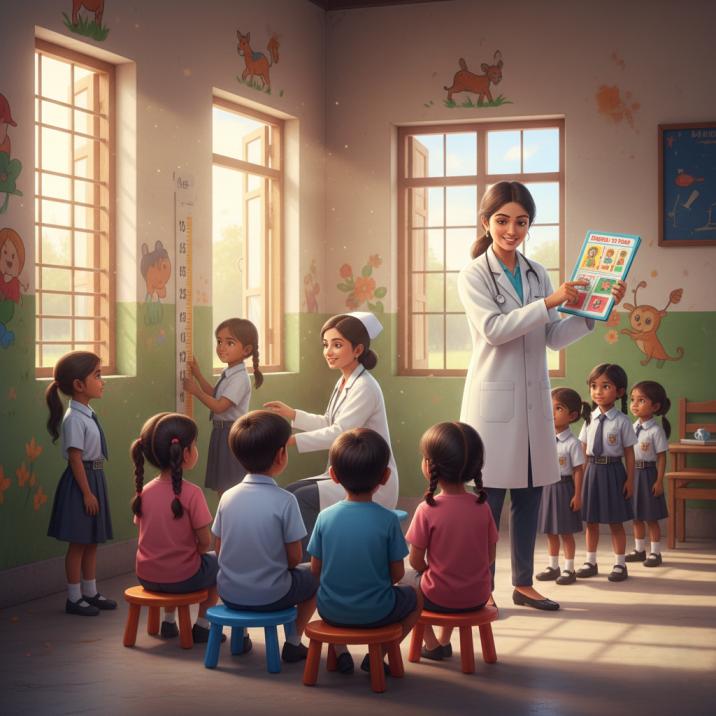
If you live in India, you might have heard of the Rashtriya Bal Swasthya Karyakram (RBSK). It is one of the largest public health initiatives in the world, aiming to screen over 270 million children for health issues.
The government recognized a critical gap: millions of children in rural and semi-urban India were growing up with undiagnosed developmental issues because they didn’t have access to big city hospitals.
To fix this, they created “Mobile Health Teams”—doctors and paramedics who travel to schools and Anganwadis. But these teams needed a tool. They needed a way to spot autism quickly in a classroom of 30 kids. That tool is the RBSK-ASQ.
The Science: The “4D” Approach
The RBSK program is designed to catch the “4 Ds”:
- Defects at birth
- Diseases
- Deficiencies
- Developmental Delays (including Autism)
The RBSK-ASQ (Autism Specific Questions) is the specialized section of this massive screening apparatus. It isn’t just a text questionnaire; it is often accompanied by a Pictorial Tool. This allows health workers (like ASHAs) to visually identify red flags—like a child flapping their hands or playing alone—even if the parents can’t articulate the problem effectively.
It is a “triage” system. It ensures that a child in a remote village gets flagged in the government system and referred to a District Early Intervention Centre (DEIC) for free treatment.
The Tool: RBSK-ASQ
This tool is primarily for use by Mobile Health Teams, but understanding it helps parents know what the government is looking for. It focuses on observation.
👉 Access the Guide: RBSK-ASQ Autism Specific Questions
What To Do With Your Score
- The “Red Flag” Method: The RBSK tool works on “Red Flags.” Even a single persistent red flag (e.g., “No eye contact at 12 months”) is enough to trigger a referral.
- The Referral Path: If your child is identified by the RBSK team:
- Do not be scared. This is the first step to getting help.
- You will be referred to the nearest DEIC (District Early Intervention Centre).
- At the DEIC, a full team (pediatrician, psychologist, speech therapist) will assess the child for free.
- Pro Tip: If you missed the school screening, you can visit your local DEIC directly and request an RBSK assessment.
Safety & Disclaimer
This content is for educational purposes.
- Government Protocol: This is an administrative screening tool used for public health triage. It is not a clinical diagnosis.
- Free Services: Remember, under the RBSK mandate, assessment and treatment for identified children are free of cost at government facilities.
References
- Ministry of Health and Family Welfare (MoHFW), Government of India. (2013). Rashtriya Bal Swasthya Karyakram (RBSK) Operational Guidelines.
- MoHFW. (2014). RBSK Job Aids: Pictorial Tool for Developmental Delay.
- Singh, A., et al. (2015). Operationalization of Rashtriya Bal Swasthya Karyakram (RBSK): Early experiences and challenges. Indian Pediatrics.