
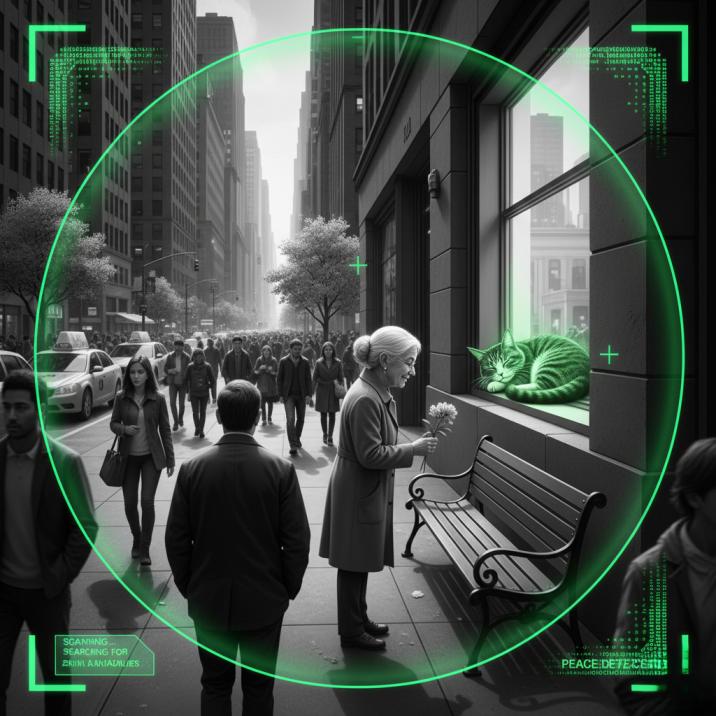
For someone with PTSD or high anxiety, the world looks like a battlefield.
You walk into a restaurant, and you immediately spot the exit. You notice the loud guy at the bar. You see the knife on the table. Your brain is stuck in Threat Detection Mode.
This is called Hypervigilance. It is exhausting. It burns through your energy because your radar never turns off.
But here is the tragedy: while your brain is expertly spotting every single threat, it is completely blind to the Safety Signals. It misses the relaxed waiter, the laughing couple, or the unlocked door. You see the danger, but you don’t see that you are actually safe.
Safety-Signal Seeker is a game designed to recalibrate your radar.
The Science: Learned Safety
Neuroscience distinguishes between “Learned Fear” (knowing what hurts you) and “Learned Safety” (knowing what won’t hurt you).
In PTSD, the Learned Safety network in the brain (involving the ventromedial prefrontal cortex) is underactive. The goal of this game is Counter-Conditioning. We want to teach your brain that scanning the environment can yield positive results, not just scary ones. We want to balance the equation.
The Game: Safety-Signal Seeker
- The Mission: You are presented with complex, cluttered scenes (a busy airport, a messy room).
- The Target: Buried in the chaos are specific “Safety Symbols” (e.g., a green shield, a dove, or a specific calming icon).
- The Twist: There are also “Threat” decoys (e.g., red spikes). Your job is to ignore the threats and click the safety signals as fast as you can.
By rewarding you for finding safety and ignoring danger, the game subtly shifts your attention bias.
👉 Play the Game: Safety-Signal Seeker
Actionable Advice
- The “Green Car” Game: Take this logic into the real world. When you go for a walk, give yourself a mission: “Today, I am going to count 5 people who look kind.” or “I am going to find 3 dogs wagging their tails.”
- Validate Your Safety: When you sit down in a chair, take a moment to consciously tell yourself: “The chair is holding me. The door is locked. I am safe right now.”
Safety & Disclaimer
- This tool is for educational purposes.
- Not for Active Crisis: If you are currently in an unsafe environment (e.g., domestic violence), hypervigilance is a necessary survival skill. This tool is for when you are physically safe but your brain hasn’t realized it yet.