
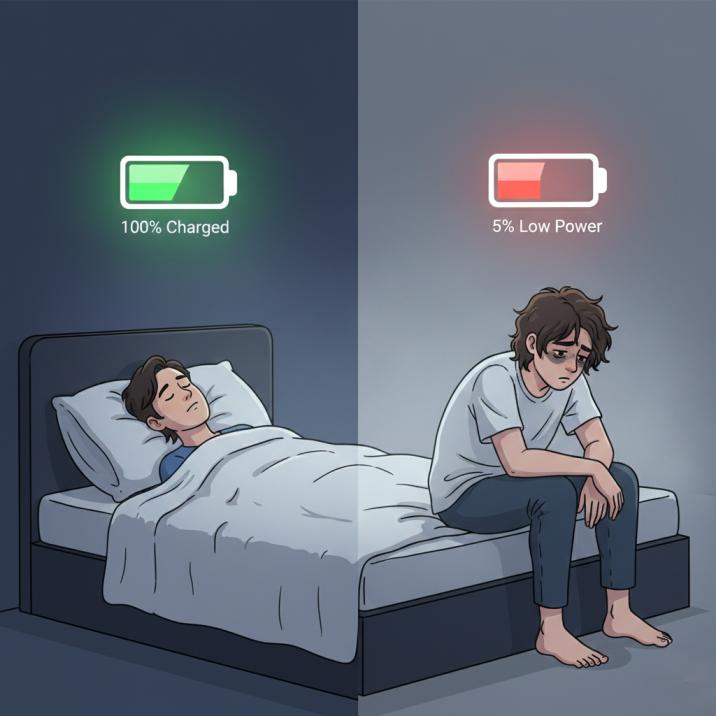
We’ve all had those mornings where the alarm clock feels like an enemy. You drag yourself out of bed, pour the coffee, and wonder, “Did I even sleep?”
Conversely, there are those rare, magical mornings where you wake up before the alarm, feeling like your internal battery is at 100%.
Sleep isn’t just about the number of hours you clock on the pillow; it’s about the quality of that time. Think of sleep like charging your phone. You can leave it plugged in for 8 hours, but if the connection is loose (poor quality), you’ll still wake up with a low battery.
The Science: Can One Question Reveal the Truth?
In a world of complex sleep trackers and smartwatches, it might seem too simple to just ask, “How was your sleep?” But science suggests your subjective experience is incredibly accurate.
Researchers developed the Single-Item Sleep Quality Scale (SQS) to cut through the noise. Instead of a 20-minute questionnaire, this tool asks you to evaluate your sleep restoration in a single, precise moment. Studies have shown that this simple self-rating correlates strongly with physical fatigue, mental alertness, and even long-term health outcomes. It honors the fact that you are the best judge of how rested you feel.
The Tool: Single-Item Sleep Quality Scale (SQS)
This is the quickest tool in the PsychKit library. It takes about 10 seconds, but it forces you to pause and honestly assess your energy baseline for the day.
👉 Take the Test: Single-Item Sleep Quality Scale (SQS)
What To Do With Your Score
If your score indicates low quality, don’t panic. Treat it as data, not a failure.
- The “3-2-1” Rule: Try this tonight. No food 3 hours before bed, no work 2 hours before bed, and no screens 1 hour before bed.
- Temperature Check: Your body needs to drop its core temperature to enter deep sleep. Ensure your room is cool (around 18°C or 65°F is often cited as ideal).
- Morning Light: Get sunlight in your eyes within 20 minutes of waking up. This resets your circadian rhythm and helps you sleep better tonight.
Safety & Disclaimer
This tool is for educational and self-monitoring purposes only and does not constitute medical advice.
- Sleep Apnea Warning: If you consistently feel unrefreshed despite sleeping 7+ hours, or if a partner tells you that you snore loudly or stop breathing during sleep, please consult a doctor. Sleep apnea is a serious but treatable medical condition.
References
- Snyder, E., et al. (2018). The Single-Item Sleep Quality Scale: Results from a validation study of patients with chronic pain. Journal of Pain and Symptom Management.
- Harvey, A. G., et al. (2008). The subjective meaning of sleep quality: A comparison of individuals with and without insomnia. Sleep.
- Cappelleri, J. C., et al. (2009). Psychometric evaluation of the Single-Item Sleep Quality Scale (SQS). Health and Quality of Life Outcomes.