
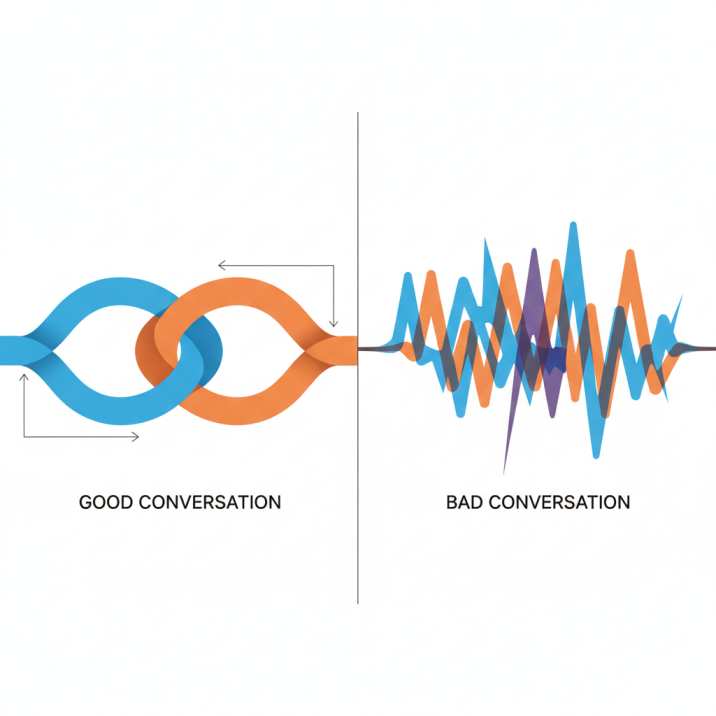
Conversation isn’t just about words; it’s about Timing.
It’s like jazz. If you come in too early, you interrupt the solo. If you come in too late, the energy dies.
Some of us are “Interrupters” (often driven by ADHD or excitement)—we jump in before the sentence is finished because we are terrified we’ll forget our thought. Others are “Pauser-s” (often social anxiety)—we wait for a written invitation to speak, and by the time we open our mouths, the topic has changed.
Turn Taking Tempo treats conversation like a rhythm game (think Guitar Hero for talking) to help you find the groove.
The Science: The 200 Millisecond Gap
Linguists have found that across almost all languages and cultures, the average gap between one person stopping and the next person starting is roughly 200 milliseconds. That is incredibly fast—faster than the blink of an eye.
To hit that gap, we don’t wait for the person to stop; we predict when they will stop. We look for “End-of-Turn Cues”: a drop in pitch, a slowing tempo, or a long gaze. This game trains you to spot those cues.
The Game: Turn Taking Tempo
- The Track: You listen to a simulated conversation (audio or text bubbles).
- The Goal: You have a “Speak” button. You must press it exactly when the virtual character finishes their point.
- The Feedback:
- Too Early: “Interruption! You cut them off.”
- Too Late: “Awkward Silence. The moment passed.”
- Perfect: “Flow State achieved.”
👉 Play the Game: Turn Taking Tempo
Actionable Advice
- For Interrupters: Practice the “One Breath” rule. When you think they are done, take one breath in. If they haven’t started talking again by the time you exhale, it’s your turn.
- For the Quiet Ones: Use “Back-channeling.” Make small sounds like “Hmm,” “Right,” or “Wow” while they talk. It keeps your engine running so it’s easier to accelerate into a full sentence.
Safety & Disclaimer
- This tool is for communication skills.
- Neurodiversity: Autistic individuals might find the standard “neurotypical” rhythm unnatural. That is okay. The goal isn’t to mask, but to understand the mechanics so you can navigate the interaction more easily if you choose to.